





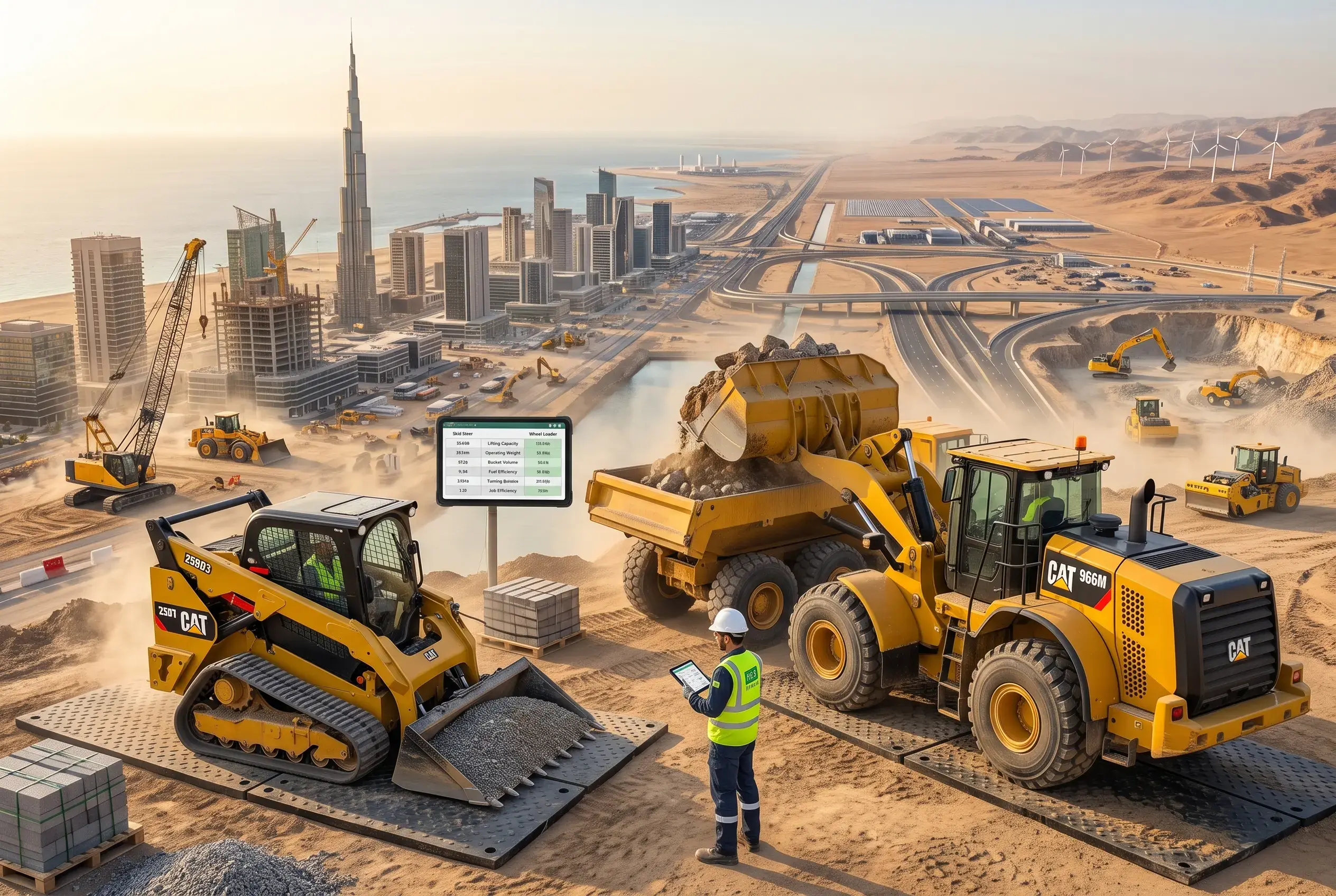
To find the best earth mover for your fleet, compare skid steer loaders and wheel loaders. Learn about their steering, lifting abilities, and job site efficiency. Choosing the right earthmoving tools is one of the most important things that needs to be done to keep a job site very productive.
A skid steer loader vs. a wheel loader is a common choice that every contractor has to make when building or growing their fleet. Even though both machines are made to efficiently scoop, lift, and move materials, they are built in very different ways. Choosing the wrong machine can result in torn-up turf, slow cycle times, or an inability to operate in tight spaces, making it essential to understand which machine fits your project parameters.
The most fundamental distinction between these two earthmovers lies in how they turn and interact with the ground surface. A classic skid steer features a rigid, one-piece frame that steers by spinning the wheels on one side faster than the other, allowing it to pivot on a zero-turn radius within its own footprint. Check Preventive Vs Reactive Machinery Repair: Which Is Better?
On the other hand, a wheel loader utilizes an articulated steering system, meaning the machine is split into two halves joined by a massive central pivot point. When the operator turns the steering wheel, the entire chassis bends in the middle, allowing the wheels to roll smoothly through a turn rather than sliding across the pavement.
Because of their distinct steering types, each machine requires a completely different amount of operating room to remain effective. Skid steers are the best tools for tight residential projects, indoor demolition zones, and narrow alleyways in cities because they are so small and low-profile.
Standard wheel loaders, on the other hand, are much bigger and need a moderate amount of turning space to be safe. However, because wheel loaders do not skid their tires during a turn, they cause minimal ground disturbance, making them much gentler on finished surfaces like fresh asphalt, pavers, or manicured grass.
If your daily operations revolve around raw lifting power and moving high volumes of bulk materials, the physical size advantage of the wheel loader becomes apparent. Wheel loaders boast much higher horsepower, greater breakout force, and a significantly larger bucket capacity, making them ideal for loading massive dump trucks or managing aggregate yards. Skid steers are relatively lighter machines with smaller engine profiles, meaning they are tailored for precision work rather than massive bulk hauling. While a wheel loader can easily carry big boulders or full pallets across long distances, a skid steer is better suited for smaller, high-frequency loading cycles.
When considering long-term ownership economics, travel speed and maintenance overhead are major factors to consider. Wheel loaders are built for speed, often reaching transport velocities between 15 and 25 miles per hour, allowing operators to drive them between nearby job sites without a trailer.
Skid steers typically top out around 7 to 12 miles per hour and require a flatbed trailer for relocation. Additionally, the constant scrubbing motion of skid steering causes rapid, uneven tire wear on hard surfaces like concrete, which leads to frequent replacement costs. Wheel loaders benefit from smooth rolling tires that experience uniform wear and boast superior fuel economy due to advanced throttle management.
For contractors who need a single machine to perform ten different jobs, the skid steer acts as the ultimate multi-tool because its universal quick-attach system supports augers, trenchers, sweepers, and hydraulic breakers. Wheel loaders can also support tools like forks or grapples, but they are primarily optimized for dedicated loading and carrying tasks. From an operational standpoint, wheel loaders position the driver much higher up, providing a spacious cab with excellent 360-degree visibility and reduced blind spots. It can feel crowded in a skid steer's enclosed, low-riding cab during long eight-hour shifts, but it has a safer, more compact center of gravity on uneven slopes.
Deciding between a skid steer loader vs. wheel loaders ultimately depends on your primary job site environment and material handling volume. If your business focuses on landscaping, urban trenching, or multi-attachment tasks in restricted spaces, the agile skid steer is your best investment.
However, if your projects demand maximum lifting capacity, high travel speeds, and continuous bulk material transport across open terrain, the wheel loader will deliver far superior productivity and lower tire wear. Matching the machine's mechanical strengths to your daily operational needs ensures a highly efficient and profitable fleet.
Why do skid steer loaders wear out tires faster than wheel loaders?
The rigid frame of a skid steer forces the tires to slide and drag across the ground to turn, which creates high friction and rapid rubber wear, especially on abrasive surfaces like concrete and asphalt.
Which machine is better for landscaping on private lawns?
An articulated wheel loader or a compact track loader is better for landscaping because standard wheeled skid steers tear up the turf and damage grass when executing tight pivot turns.
Can a wheel loader lift more weight than a skid steer loader?
Yes, wheel loaders are engineered with a larger chassis, wider stance, and higher hydraulic pressure, giving them a significantly greater tipping load and lifting capacity compared to compact skid steers.
Are skid steer loaders easier to move between different jobs?
Yes, due to their smaller dimensions and lighter operating weights, skid steers can easily fit onto standard utility trailers and be towed behind a standard pickup truck without special permits.
For what reason does articulated steering on a wheel loader make it better?
The machine can bend in the middle thanks to articulated steering, which makes the ride smoother, keeps all four wheels firmly on the ground for better grip, and stops tire slippage in certain areas.


Leave a comment
Your email address will not be published. Required fields are marked *