





Learn why it is important to install swing bearings on [company_name]. Discover how precise alignment and torque can prevent downtime, and preserve asset value.
Swing bearings are located beneath the upper structure on heavy equipment. They allow 360-degree rotation without any noise. It is rarely the focus of daily discussions in workshops, but its seamless integration is crucial to an excavator’s performance.
Poorly fitted slewing rings can have negative effects that extend far beyond the repair shop. They can cause unexpected delays on the job site, safety hazards and costly mechanical repairs. This setup is rigorous, and fleet owners can minimize their operational risks by understanding it.
The swing bearing is the connection between an excavator’s upper cabin and its undercarriage track system. This heavy-duty part must handle massive radial and axial moment loads, as well as tilting moments, simultaneously, while the machine digs and lifts. Read also Installing Swing Bearing
Even a slight imperfection can affect the machine's balance because it is the component that bears these heavy forces. Proper installation ensures a stable center of gravity, predictable hydraulic performance and prevents stress cracks from spreading to the lower frame.
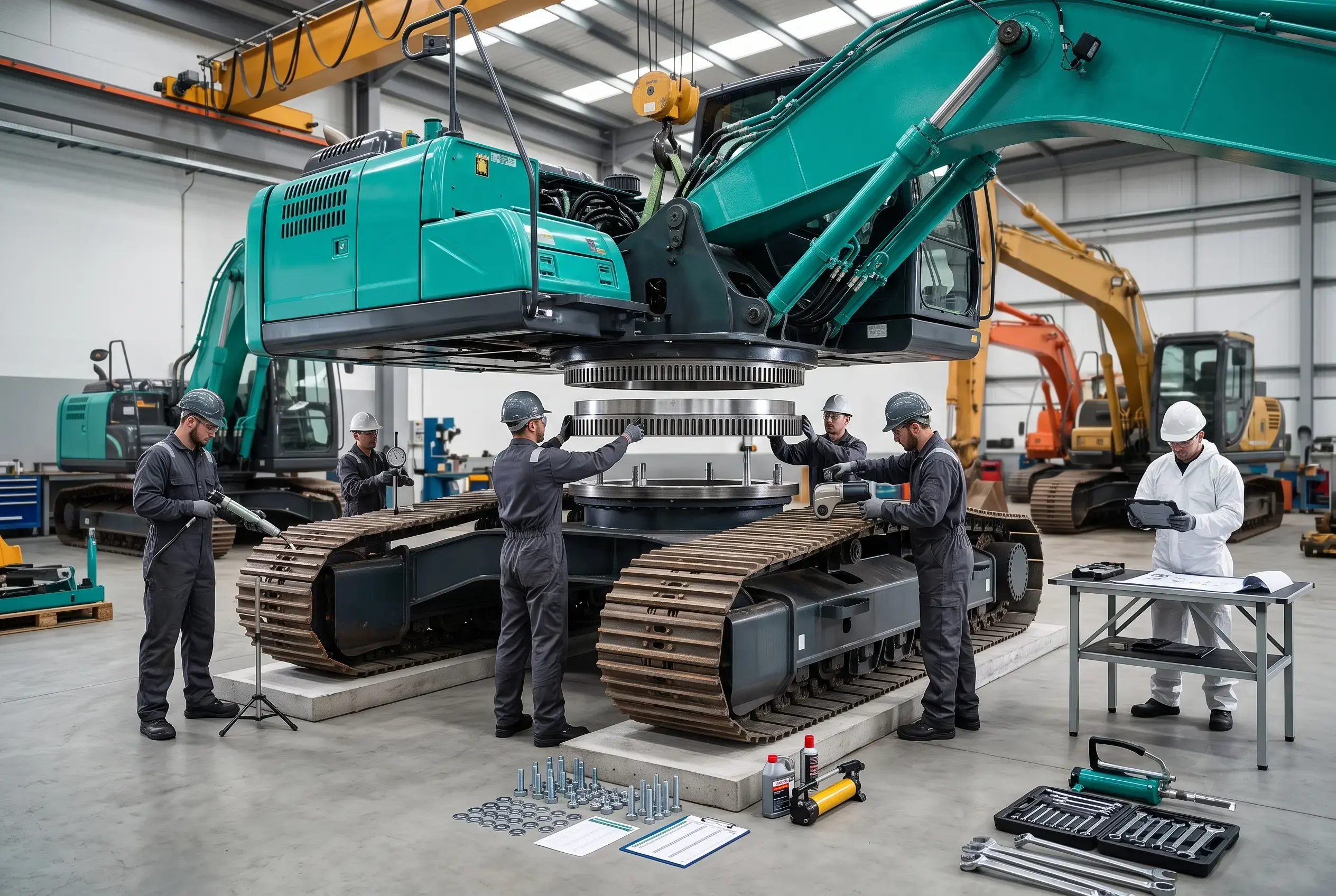
To achieve a perfect swing-bearing installation, a multi-step mechanical process is required. The technicians must then safely separate the upper structure from the track chassis by using heavy lifting jacks or specialized industrial cranes.
After the old bearing has been removed, the mounting surface must be cleaned meticulously and the flatness checked using dial indicators. Before threading any hardware, the new bearing must be carefully aligned so that the gear mesh teeth are positioned correctly in relation to the main drive shaft.
The majority of premature bearing failures are caused by basic assembly steps that were rushed or ignored. If you leave tiny flakes of rust, paint, or grit behind on the mounting surface, this can lead to small gaps, which will result in an uneven load distribution.
Reusing old mounting screws is another common mistake. The design of swing bearing fasteners is to allow them to slightly stretch when they are tightened up to their maximum capacity. This means that if you reinstall the bolts, their clamping power and elasticity will be lost.
To secure a heavy rotating ring, it is important to adhere to the exact torque values and tightening pattern specified by the manufacturer. The technicians should avoid the use of pneumatic impact tools, as they can result in an uneven, erratic tightening across the bolt circle.
They should instead use calibrated manual torque tools or hydraulic tensioning gear to apply pressure in an alternating star pattern. This method is precise and prevents internal bearing raceways from warping. It also ensures uniform load distribution across all fasteners.
Before the machine is put back into service, a rigorous and ongoing lubrication programme must be established. High-pressure grease is a barrier that helps prevent metal-to-metal contact between internal bearings, ball and raceways, while also blocking dirt and moisture.
The technicians should rotate the machine while pumping clean grease into the fittings. This will ensure that the entire internal surface is covered. Purging the old grease regularly protects internal gears against pitting and helps to prevent premature wear. This will keep the equipment running smoothly for many years.
A flawless installation of swing bearings is an investment in structural precision that determines the safety, efficiency and market value of a machine. If you skip steps such as surface cleaning or torque calibration, it will result in costly downtime.
Fleet managers who treat this complicated procedure with the technical respect that it deserves can lower their operating costs over time, ensure high safety standards on site, and make sure their heavy machinery is producing maximum productivity at every project.
Proper installation will ensure that all the forces, including vertical, horizontal and twisting, generated by heavy digging, are evenly distributed across the frame. It eliminates excessive vibration, prevents structural cracking and ensures smooth cabin rotation.
Swing bearing bolts have a high tensile strength and are designed to be slightly stretched to obtain the ideal clamping force. They lose their structural integrity and elasticity after use, which makes them more susceptible to snapping or loosening if they are reinstalled.
High spots can be caused by even tiny particles of dirt or rust trapped under the bearing. This uneven seating leads to localized stress, which can warp the internal raceways, causing bearing failure.
A jerky rotation of the cabin, unusual clicking and grinding sounds, or an increase in hydraulic resistance while swinging are all signs of a bad preload. A bearing that is properly installed will spin smoothly and quietly.
While the excavator rotates slowly, grease must be pumped through the bearing's fittings. The machine must be rotated during lubrication to ensure that the grease is evenly distributed across the internal gears and ball bearings.


Leave a comment
Your email address will not be published. Required fields are marked *