




Learn how Dubai's Next Generation Loop Transport Vision is driven by heavy-duty tunneling equipment. Discover Phase 1 statistics, costs and the ultimate future for urban commuters.
Dubai is always thinking outside the box when it comes to infrastructure. An underground system aimed at changing mobility forever is currently being built. This system, developed in collaboration with Elon Musk's Company, will use some of the most advanced heavy machinery in the world to carve tunnels into the ground in one of the most densely populated cities.
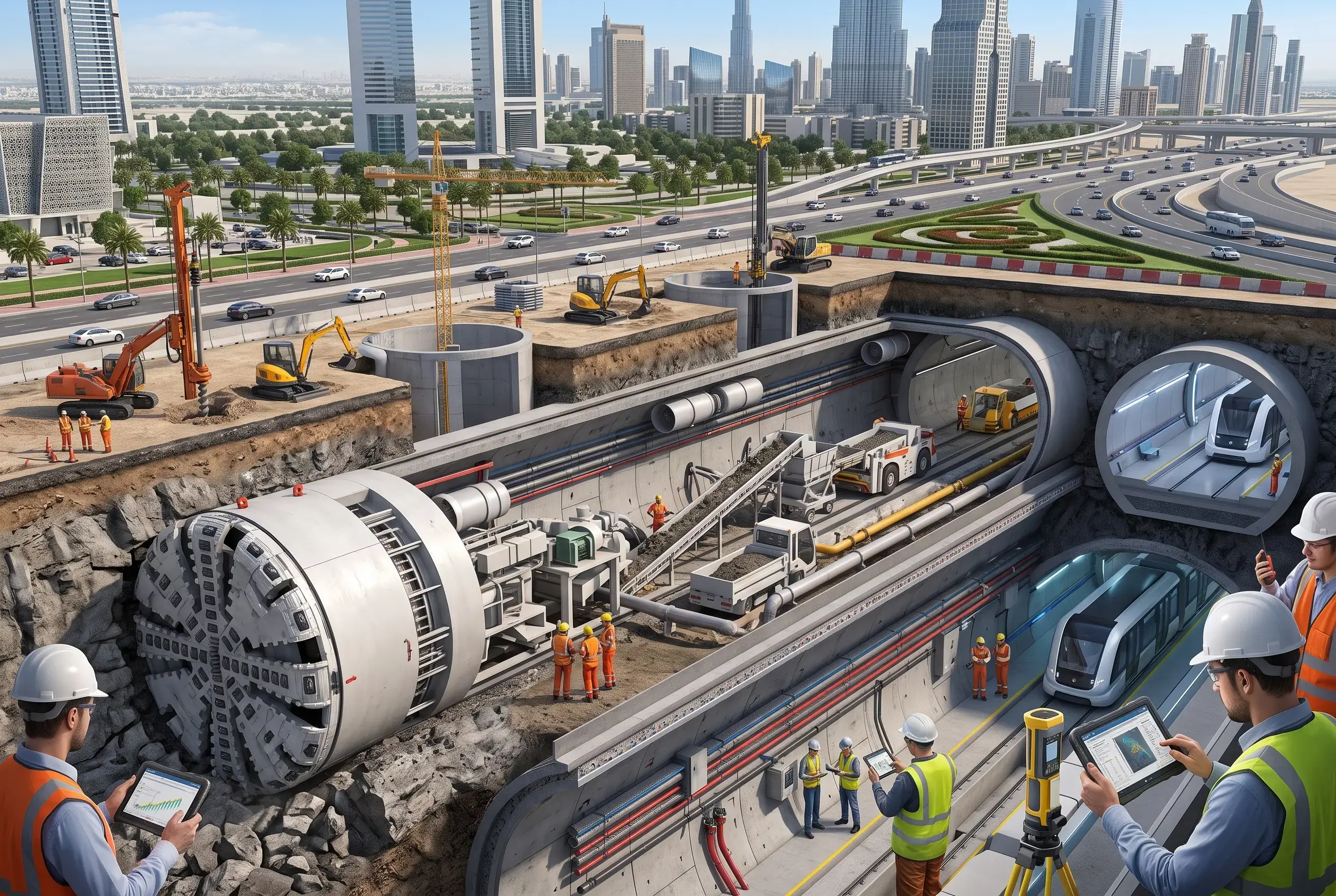
What this system relies on the most is specialized, advanced heavy machinery. The constraints of drilling under busy skyscrapers and mega malls make standard excavation impossible. This project will use the newest generation of Tunnel Boring Machines (TBM). These machines are designed to drill safely in under 3.6-meter (approx. 12 feet) diameter tunnels. These machines are so advanced that crews are able to dig with extreme precision. Because TBM's operate completely underground, the major roadways in Dubai, including Sheikh Zayed Road, will remain open. This project is a giant leap in the world of heavy construction. It proves that tight urban spaces can accommodate large underground construction projects.
The system is designed to completely bypass the surface traffic and move passengers in fully electric vehicles at high speed. Because of how rapidly the first phase is designed to be scaled, the project will be accomplished in two main construction phases.
Phase 1: The Central Core
The focus of this phase is a 6.4 kilometer section of the system. This section will first connect the Dubai International Financial Centre (DIFC) and Burj Khalifa and will greatly shorten the travel time for a standard trip from 20 to 3 minutes.
Phase 2: Total Downtown Connectivity
Once the heavymachinery moves past the first phase, the network will expand considerably. The extended network would ideally span 22.2 kilometers to connect all the major business, tourism, and retail areas.
The financial implications of this project, combined with its operational requirements, are a testament to the magnitude of modern-day civil engineering:
Project Metrics Phase 1 (Pilot Phase) Phase 2 (Establishment of Entire System)
Length of the Route 6.4 Kilometers (4 Miles) 22.2 Kilometers (13.8 Miles)
Number of Stations: 4 Key Strategic Hubs: 19 Integrated Stations
Project Costs AED 565 Million ($154M USD) AED 2 Billion ($545M USD)
Increased Passenger Capacity 13,000 Commuters 30,000 Commuters
Timeframe for Project 1 Year 3 Years
Engineering Hurdles Overcome through Advanced Fleet Technologies
Excavating tunnels that are several meters deep poses clear engineering challenges. Fleet Managers and Engineers rely on specific heavy-duty equipment to clear the site, while maintaining safety:
Compact Excavators & Loaders: Scaled-down heavy earthmovers that can work directly in the 3.6-meter shafts and can effectively haul out rock and soil.
Electric Mucking Systems: Automated heavy conveyance that continuously removes dirt, enabling the boring heads to maintain the forward position.
Smart Slurry Pumps: High-pressure fleets that control the pressure of water underground to eliminate settling and shifting of the structures above.
An example of tunneling innovation is Dubai's Next-Gen Loop Transport Vision. Surface traffic and street congestion are avoided using advanced machinery to build highly compact and inexpensive tunnels. This project shows that with the combination of advanced machinery, construction progress, and bold designs, sustainable transport systems can be built beneath the surface.
What is Dubai's Next-Gen Loop Transport Vision?
This vision includes a high-speed, underground, and electrified transportation system that connects various commercial and financial districts using a network of 3.6-meter-diameter tunnels.
What heavy machinery company is responsible for the tunneling?
Elon Musk's The Boring Company, an advanced tunneling technology company, is a close partner with the Dubai RTA, and they provide the specialized Tunnel Boring Machines (TBMs).
What is the maximum speed in the transport loop?
The traveling time of surface commutes is significantly reduced by the high-speed design of the transport system. The maximum speed of the system is 100 mph (160 km/h).
What stations are in the first phase?
The first phase includes stations in the Dubai International Financial Centre (DIFC), ICD Brookfield Place, the Dubai Mall Parking in Za'abeel, and Burj Khalifa/Dubai Mall.
How does the project minimize the impact on traffic?
Major road closures and construction activities above ground are not required, and tunneling to create the transport system is significantly advanced and specialized to have a low impact on surface traffic.


Leave a comment
Your email address will not be published. Required fields are marked *