





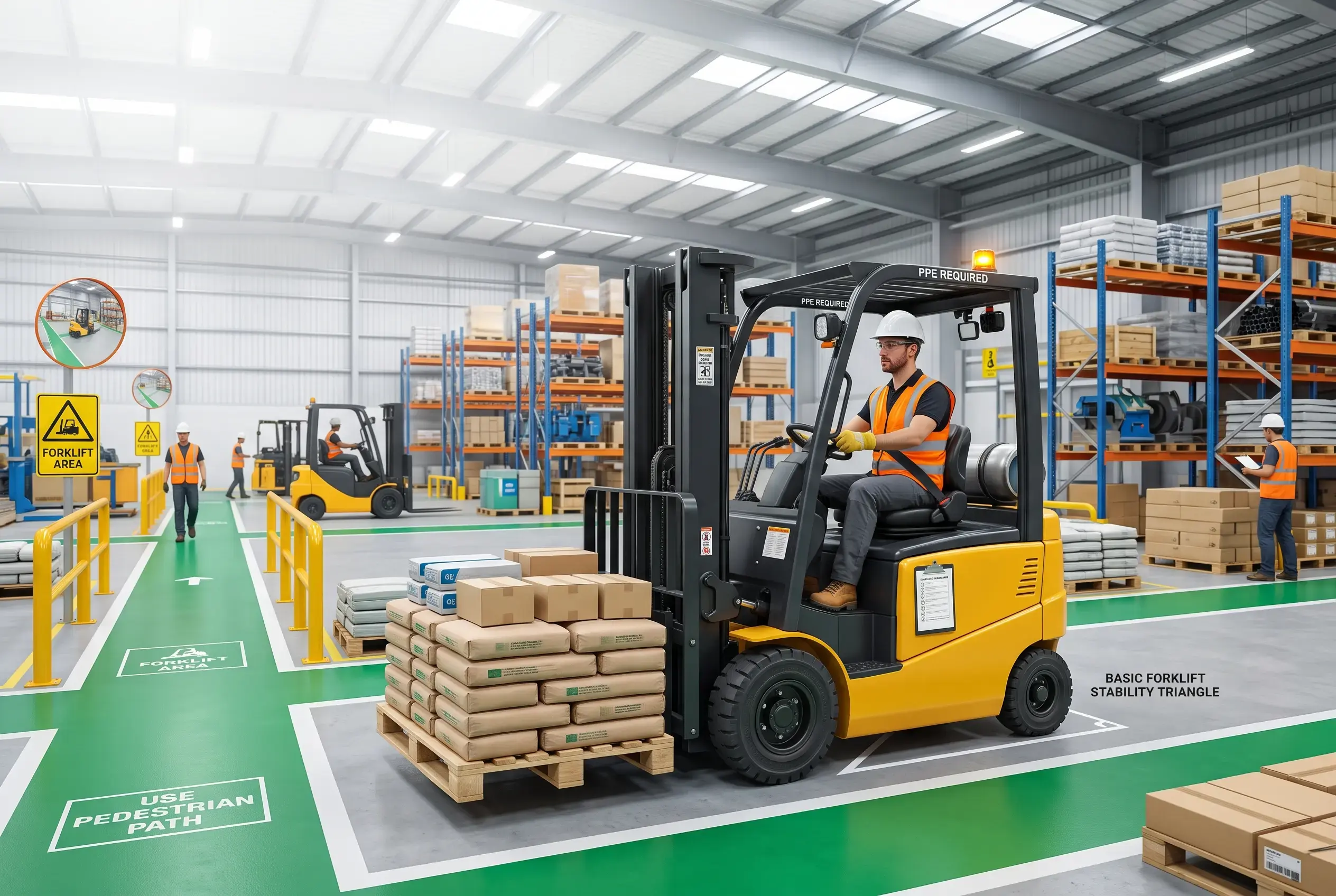
Our comprehensive guide on forklift safety will help you to reduce workplace hazards and protect yourself and your team. Learn how to perform effective pre-shift checks, understand the stability triangular, and create pedestrian safe zones. Implement these operational practices to create a proactive and accident-free work environment.
Forklifts are used every day to power warehouses, construction sites and logistic hubs. It is amazing how they can move thousands of pounds with ease. It's easy to forget how powerful and dangerous these machines are because they are so common.
Read Also The Excavator Guide: Answers to the 4 Most Common Questions
One moment of distraction, or even a missed safety check, can transform a normal shift into an accident. It's not about luck, but about building a culture of awareness and good habits. Let's look at the practices that will keep your team and inventory safe while keeping your business running smoothly.
A thorough walk-around is required before anyone steps on a machine or turns the key. Consider this checklist as the pilot's preflight checklist. Operators should check the fluid levels and look for any visible hydraulic leaks. They must also inspect the condition of tires.
Before entering a work zone, it is important to test brakes, steering, backup alarms, and the horn. The forklift should be shut down and reported immediately if even one part feels wrong or does not pass inspection. A minor mechanical fault in the parking bay can prevent a structural failure of the warehouse.
To operate a forklift safely, you must adhere to certain driving principles that are designed to protect all workers. Always drive at a safe pace and reduce your speed when approaching corners, doors, or intersections.
Operators are advised to sound their horns at each crossroad in order to alert any pedestrians who may be hidden. If a heavy, bulky load is blocking your view forward, you will need to drive in reverse. Never carry passengers on a forklift unless it is specially designed to have a second seat and a seatbelt installed in the factory.
Engineers call this system the stability triangle. The three points are the two front wheels and the center rear axle. The forklift will remain stable as long as its center of gravity is safely contained within this imaginary triangle.
Carrying an unbalanced weight, turning too quickly, or driving up an incline can shift this center of gravity outward and cause a tip-over. To maintain the balance of the machine, center the load, tilt the mast slightly back during transport and keep the forks as low as possible.
The safety of forklifts is not solely the responsibility of the driver; pedestrian awareness is equally important. Worksites should have highly visible floor markings or painted walkways that clearly distinguish walking paths from lanes for heavy machinery. Avoid walking behind machines and lifts where the blind spots are most prominent. By making eye contact with an operator before crossing the path, both parties will be aware of their movements.
Do not exceed the weight limit listed on your data plate. Overloaded trucks can cause the truck to lose control and tip forward.
Consistency is the key to a safer workplace. The use of floor markings and high-visibility vests is great, but what really makes a difference is when your team adheres to daily inspections. They also need to be aware of their surroundings and respect machine weight limits. These forklift safety guidelines can be incorporated into your daily routine to protect your workers, your cargo and your crew.
Forklifts can tip over because of unbalanced or overweight cargo, accidents with pedestrians nearby, or driving off the edge. The majority of these accidents can be avoided by ensuring that operators are properly trained and constantly aware of their surroundings.
At least every three years, formal evaluation and refresher courses should be conducted. If an operator is involved in an accident, has a near miss, or is given a forklift of a different class, they must undergo immediate retraining.
The operator should remain inside the cabin and hold the steering wheel tightly. They must also brace their legs, leaning in the opposite direction to the tilt. The most common cause of injury or death is trying to jump out of the forklift when it's tilting. This can be dangerous because the overhead guard of the machine can trap an operator.
The machine's stability is maintained by keeping the forks close to the ground. This gives the operator an improved view of the path and helps prevent the forks from hitting overhead fixtures or structural beams.
Safety is everyone's responsibility. Employers are responsible for providing OSHA-compliant safety training and maintaining well-maintained equipment. Operators are also responsible for following daily safety protocols, inspection rules and remaining alert.


Leave a comment
Your email address will not be published. Required fields are marked *