





Find out how concrete mixer pump trucks mix and pump the concrete into one high-efficiency machine. This comprehensive guide covers their core functions, major benefits, and key factors to consider when choosing one for your construction site. Start today to speed up your next concrete pour and cut down on labor costs.
Managing a busy construction site requires smart machinery that saves both time and labor costs. If you still use separate transit mixers and stationary pumps to pour concrete, you are not making the most of how much time and money you can save. Concrete mixer pump trucks are changing the game by combining two essential jobs into a single mobile unit. This combination of powerful machines lets teams mix new concrete on-site and pump it right to high or hard-to-reach places.
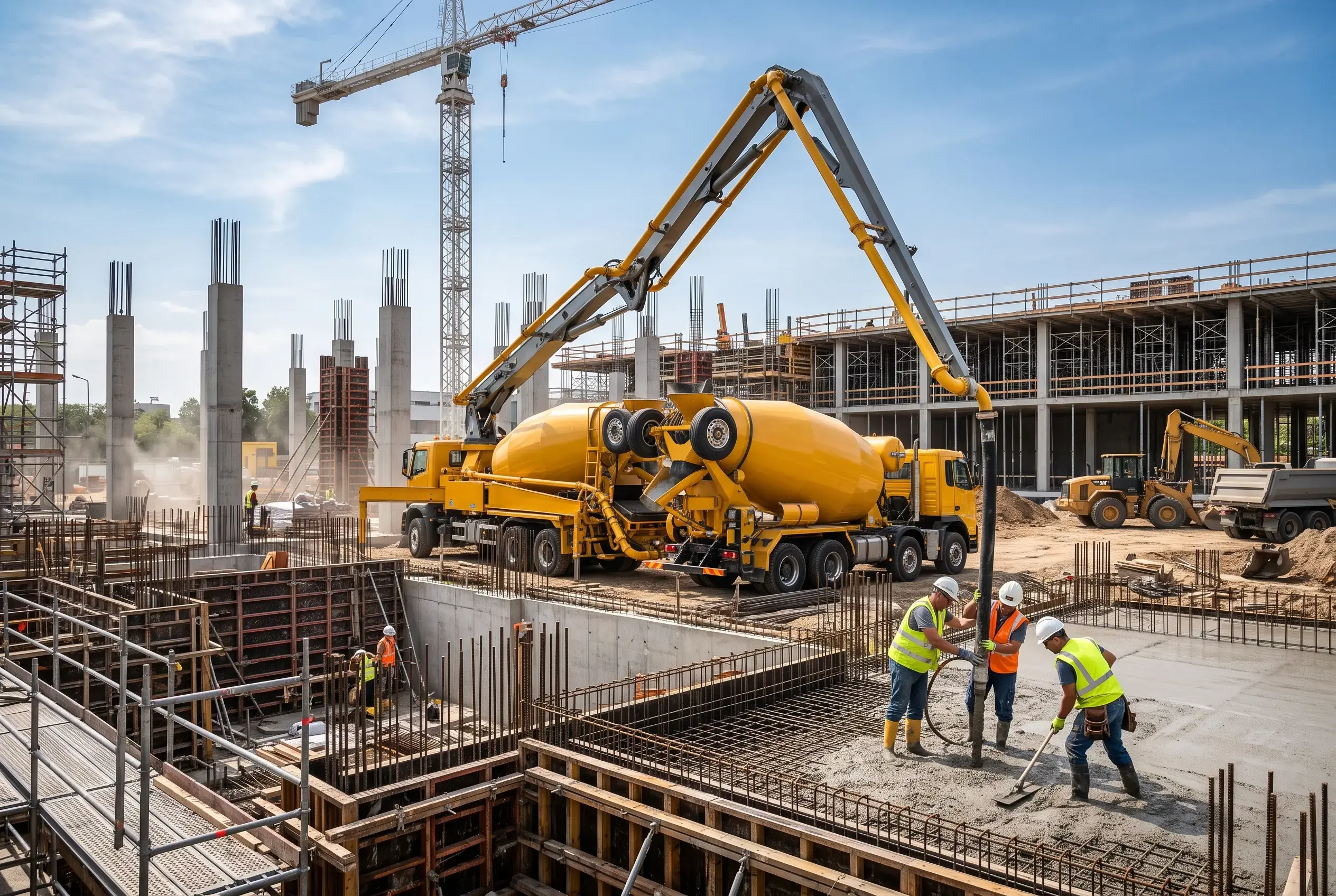
A concrete mixer pump truck is a mobile solution that can do everything needed to make putting down concrete easier in modern construction. It has a strong truck chassis that holds a heavy-duty mixing drum or pan mixer and a high-pressure hydraulic pumping system. This design allows the vehicle to drive directly to a job site, mix raw aggregates, cement, and water, and immediately deploy a boom or pipeline to deliver the fresh mix.
Read Choose the Right Bucket for Your Wheel Loader
These versatile trucks are highly popular for medium-sized projects, residential developments, rural bridge building, and urban spaces where site space is limited. By consolidating transportation, mixing, and delivery into one machine, fleet owners drastically cut down on equipment footprint. Instead of coordinating delivery schedules between multiple vehicles, a single operator can manage the entire concrete production and pouring pipeline.
The workflow of a mixer pump truck is beautifully engineered for speed and continuous operation. First, the raw materials are put into the onboard hopper or aggregate batching system. The mixing drum then makes a concrete blend that is perfectly even. Once the batch gets the proper slump and density, the drum reverses or releases the wet mix straight into the pumping mechanism.
The underlying pumping system relies on powerful hydraulic pistons to force the concrete through a series of rigid delivery pipes or a flexible placement boom. There is almost no space between the mixing chamber and the pump hopper, so there is no chance that the concrete will separate or dry out while it is being moved. This continuous cycle ensures a steady, unbroken stream of concrete to the exact spot where your crew needs it.
Investing in this dual-purpose machinery brings immediate financial and operational advantages to your construction business. The most noticeable benefit is the drastic reduction in manual labor, as you no longer need large wheelbarrow crews or crane operators to transport concrete across the site. A small team can manage the pump pipeline, while the truck handles the heavy lifting and material distribution.
Operational flexibility is another major asset because these trucks excel in tight spaces where large transit mixers cannot maneuver. Their long-reaching hydraulic booms can navigate around obstacles, power lines, and deep excavations to drop concrete precisely. Furthermore, mixing the concrete fresh on-site eliminates the strict time anxiety associated with ready-mix delivery trucks stuck in heavy traffic.
Choosing the perfect truck for your fleet requires balancing your typical project sizes with the machine's mechanical limitations. You must evaluate the maximum pumping distance, both horizontally and vertically, to ensure the truck can reach your highest or furthest pouring zones. Standard models can comfortably pump concrete up to 300 meters horizontally and 80 meters vertically, but heavy-duty variants offer even greater range.
You also need to look closely at the hourly output capacity, which usually ranges from 30 to 50 cubic meters per hour. If your business focuses primarily on residential foundations and short pathways, a compact, lower-capacity unit will maximize your fuel efficiency. If you want to keep your project on schedule, you need to choose a high-pressure system with a bigger mixing drum for commercial foundations or buildings with more than one floor.
Concrete mixer pump trucks represent the ultimate evolution in project site efficiency by merging production and distribution into a single asset. They take care of all the logistics, cut down on labor costs, and give contractors full control over the quality of the concrete and when it's poured. Adding one of these versatile machines to your fleet is a guaranteed way to speed up your project timelines and outbid the competition.
What is the main difference between a standard concrete pump truck and a mixer pump truck?
A standard pump truck only pumps pre-mixed concrete delivered by other transit mixers. A mixer pump truck can actually load raw materials, mix the concrete internally on-site, and then pump it using its own onboard system.
What types of projects are best suited for a concrete mixer pump truck?
They are ideal for small to medium-sized projects such as residential housing, rural roads, small bridges, tunnels, and urban construction sites where space is too tight for multiple large vehicles.
How far can a typical mixer pump truck deliver concrete?
While exact specs vary by manufacturer, a standard model can pump concrete roughly 200 to 300 meters horizontally and 50 to 80 meters vertically through its pipeline system.
Is it tough to keep a concrete mixer pump truck?
It requires disciplined daily cleaning. Because it handles both mixing and pumping, the drum, hopper, and pipes must be fully flushed with water after every project to prevent hardened concrete from damaging the components.
Can these trucks handle hard aggregate mixes with big stones?
Most modern mixer pump trucks are designed to handle aggregate sizes up to 3 to 4 centimeters. Still, you must always match the concrete mix design to the specific pipe diameter and pump valves recommended by the manufacturer.


Leave a comment
Your email address will not be published. Required fields are marked *