





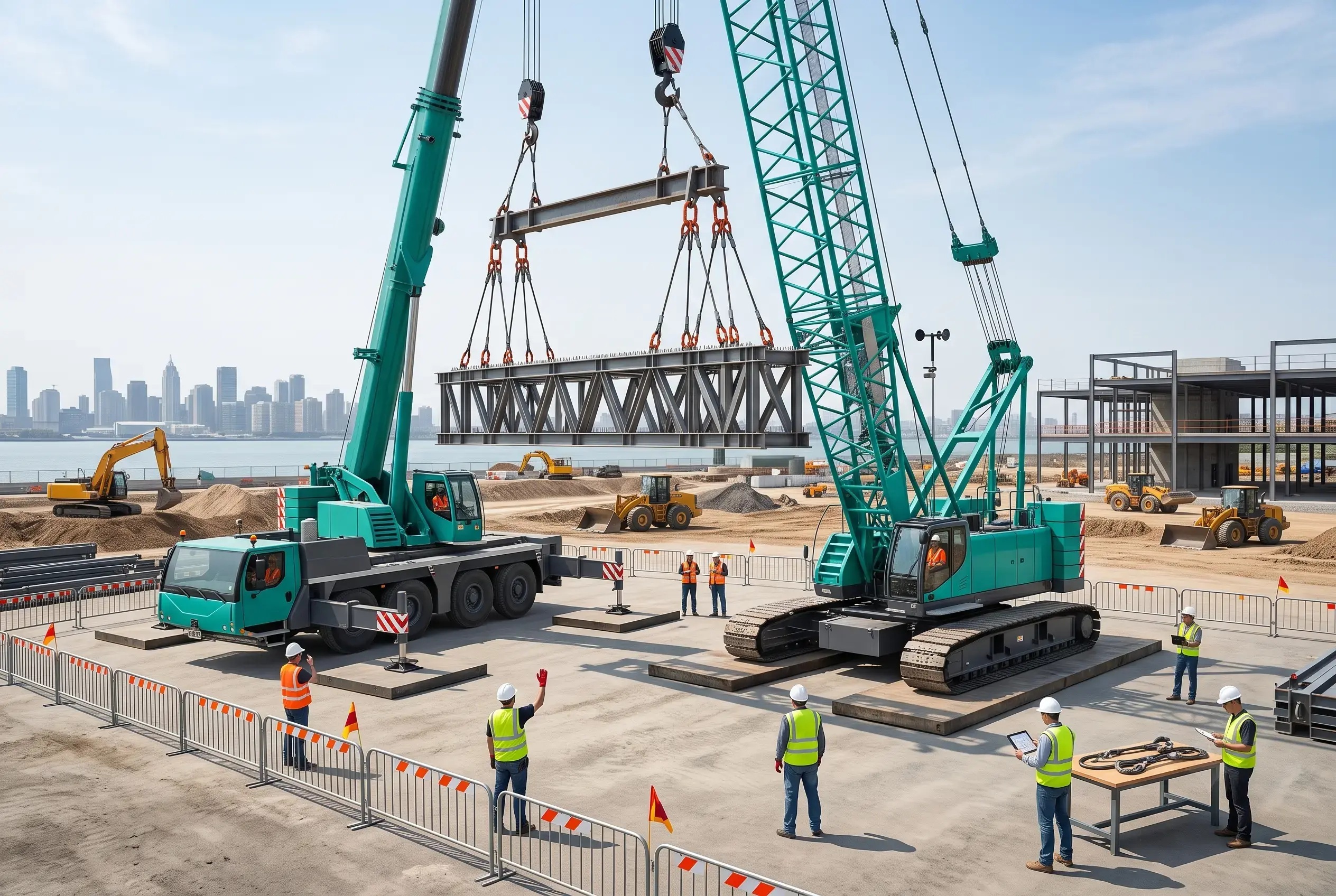
Protect your project site and maximize your investment. Read [company_name] essential crane safety guidelines for operators and buyers to ensure risk-free lifting operations.
The crane is the most powerful piece of heavy machinery. It can lift tons of steel, cement, and industrial equipment into the air. Due to their enormous power and size, cranes require a commitment to safety that is uncompromising from the crew on site and investors who purchase the machinery.
One overlooked detail could lead to a catastrophic structural failure or serious site accidents. Establishing clear safety protocols is important for protecting your employees and financial assets, whether you're operating a crane tower or purchasing a mobile unit.
Safety begins before the crane engine even starts. Operators should conduct daily walkarounds before lifting to check for hidden cracks or leaks. The technicians must carefully examine the structural integrity and wire ropes to check for fraying, kinking or signs of fraying.
They should also ensure that outriggers are fully deployed in order to create a stable footprint. If this phase is skipped, mechanical problems can escalate to structural failures under high tension.
Overloading is one of the most common causes of tip-overs and collapses of booms. Each lift must be carefully planned by using the load chart for the crane, which calculates the safe lifting limits according to the boom's angle, length and radius. Operators should never rely on instinct or guesswork.
They must use Load Moment Indicators that function and anti-two-block devices, which alert the cabin when structural thresholds have been reached. Lifts must be kept within the safe limits to prevent structural fatigue. This also keeps equipment in perfect balance.
Safety begins with the equipment buyer by verifying its full service history, maintenance records, and previous structural repairs. Buyers of used cranes should consider investing in third-party independent inspections that are certified to detect micro-cracks at welding points and deep metal fatigue.
Buyers should also ensure that their crane model adheres to local occupational safety laws and that parts from the original manufacturer are readily available for future service needs.
Cranes can be sensitive to changes in the outdoor environment, so it is important that environmental conditions are monitored continuously during a lift. Wind speeds can act as an invisible force that can cause a crane to tip over or a heavy load to swing out of control.
Ground crews should also ensure that the soil or concrete pad beneath the machine is firmly compacted to support the weight. Operators are also required to maintain a mandatory distance of at least three feet from electrical power lines in order to eliminate any electrocution risks.
Even the most advanced safety features will not be effective without a coordinated, highly-trained team performing the lift. Operators are required to hold current, valid professional certifications which prove that they have a thorough understanding of complex load dynamics as well as emergency control procedures.
Read Emergency Protocols for Heavy Equipment on Active Sites
A dedicated signal person on the ground must use clear, uninterrupted radio channels or universally recognized hand signs to guide the operator’s blind spots. A culture that empowers any member of the crew to stop lifts if they see a danger will prevent workplace accidents, and also protect expensive machinery investments.
The best way to reduce liability insurance costs and increase project productivity is to adhere to these essential guidelines for crane safety. A safety-first mentality ensures that buyers are choosing machinery that will be a reliable asset for the long term, rather than one which could become a financial liability.
Operators can ensure that every heavy lift will be executed flawlessly by adhering to the load limits and performing daily mechanical checks. Construction firms can protect their workers by making crane safety a core business. They also built a reputation for flawless operation.
Operators should carefully inspect the structural integrity and condition of the boom. They must also examine the wire ropes to ensure they are not frayed, check hydraulic fluid levels and make sure that all outriggers are correctly deployed on stable pads.
Buyers should ask for comprehensive maintenance logs and check accident reports. They can also hire a certified technician who will perform non-destructive tests to detect hidden metal fatigue or microcracks within the welds.
Load moment indicators are electronic sensors which track the weight and angle of the boom. They alert the operator in real time to prevent overloading or tipping.
Wind speeds exceeding 32 km/h to 48 km/h (20 mph - 30 mph) can cause loads to become unstable. Specific limits will vary depending on the crane manufacturer and size.
The signal person is the operator's extended eye on the ground. They monitor for changing ground conditions, track blind spots, keep an eye on power lines and make sure pedestrian exclusion zones are clear.


Leave a comment
Your email address will not be published. Required fields are marked *