





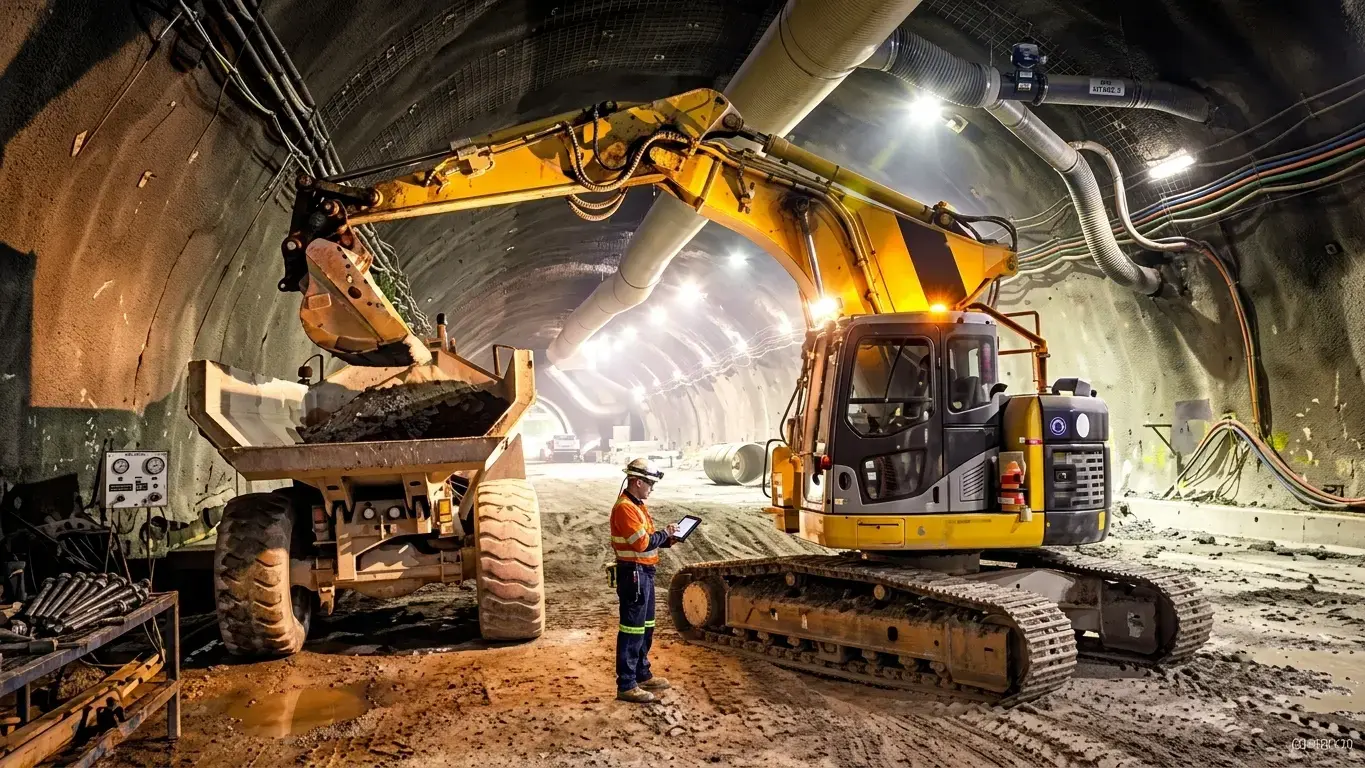
Learn about Oslo's innovative approach to urban development through its commitment to 100% emission-free construction. Delve into advancements in battery technology, heavy machinery, and important performance indicators.
In 2019, Oslo made history by launching the world's first zero-emission construction site at Olav V Gate. Instead of traditional diesel engines, the project deployed fully electrified, battery-powered, and cable-connected heavy excavators and wheel loaders.
What began as an ambitious pilot program quickly grew into standard operational policy. By 2024, an astonishing 85% to 94% of all energy used on municipal construction sites in Oslo was entirely emission-free. The city has effectively turned its urban projects into a real-world testing laboratory, proving that massive earthmoving and civil works can be executed flawlessly without burning a single drop of fossil fuel.
The rapid shift to electric fleets did not happen by accident; it was pushed forward by strategic government action. Since Oslo's municipal government accounts for roughly 20% of the local construction market, it holds massive purchasing leverage. Read also Sinoboom Telehandlers Land in the GCC
In 2017, the city launched a strict procurement strategy requiring all municipal tenders to prioritize zero-emission equipment. Contractors bidding on public projects are explicitly scored higher if they utilize electric trucks and heavymachinery over diesel or even biogas alternatives. This long-term predictability gave local rental companies and contractors the financial confidence to invest heavily in expensive, cutting-edge electric fleets, knowing they would be rewarded with stable municipal contracts.
Transitioning an entire city's heavymachinery sector to electric power brings serious technical challenges, particularly when operating machines over 8 tons. Heavy-duty battery packs require significant electrical currents to recharge, creating a sudden, high demand on the local power grid.
Oslo tackled this by working closely with grid operators, utilizing smart power-management systems, and deploying mobile "PeakShaver" battery storage units to handle high-demand surges. Furthermore, contractors have successfully managed battery performance in temperatures dropping as low as $-25^\circ\textC$, proving that electric machinery can withstand harsh Nordic winters with proper planning and thermal management.
Oslo's ultimate goal is to achieve 100% emission-free public and private construction by 2030. However, the capital city recognizes that it cannot scale this revolution alone; it requires original equipment manufacturers (OEMs) to shift toward mass production to drive down high upfront equipment costs.
Through international networks like the Big Buyers Initiative and the PURE Project, Oslo is sharing its data and frameworks with cities like Copenhagen, Amsterdam, and London. By creating a unified global demand for electric heavy machinery, these cities are forcing global manufacturers to rapidly scale up assembly lines for large electric excavators, crawlers, and transport trucks.
Oslo has decisively shattered the myth that heavy construction must be loud, dirty, and dependent on fossil fuels. Through bold political willpower, clever procurement frameworks, and close cooperation with the engineering sector, the city has set a new global gold standard. As heavymachinery electric heavy machinery becomes more commercially available and cost-efficient, cities worldwide will look to Oslo's blueprint to build the clean, quiet, sustainable metropolises of tomorrow.
Sites utilize a mix of high-capacity battery packs, rapid-charging infrastructure, and heavy-duty tethered cables connected directly to the city's electrical grid. Mobile battery storage units are also used to manage power demands without overloading the local grid.
Yes. Modern electric excavators and wheel loaders deliver identical, and often superior, instant torque compared to diesel equivalents. Oslo's projects prove that electric machinery handles heavy-duty excavation and infrastructure development without any loss in performance.
While extreme cold down to $-25^\circ\textC$ impacts battery efficiency, contractors mitigate this by using insulated battery systems and scheduled thermal pre-heating. Oslo's continuous winter operations prove that electric machinery remains reliable in freezing climates.
The two biggest benefits are the elimination of toxic air pollutants (like nitrogen oxides and particulate matter) and a massive reduction in noise. Electric sites are 5 to 10 times quieter, significantly improving the health and comfort of nearby communities.
Yes, global manufacturers are rapidly expanding production. While smaller electric equipment (under 8 tons) is already mass-produced, heavy-duty electric machinery is increasingly hitting the market as more cities adopt Oslo's green procurement policies.


Leave a comment
Your email address will not be published. Required fields are marked *