





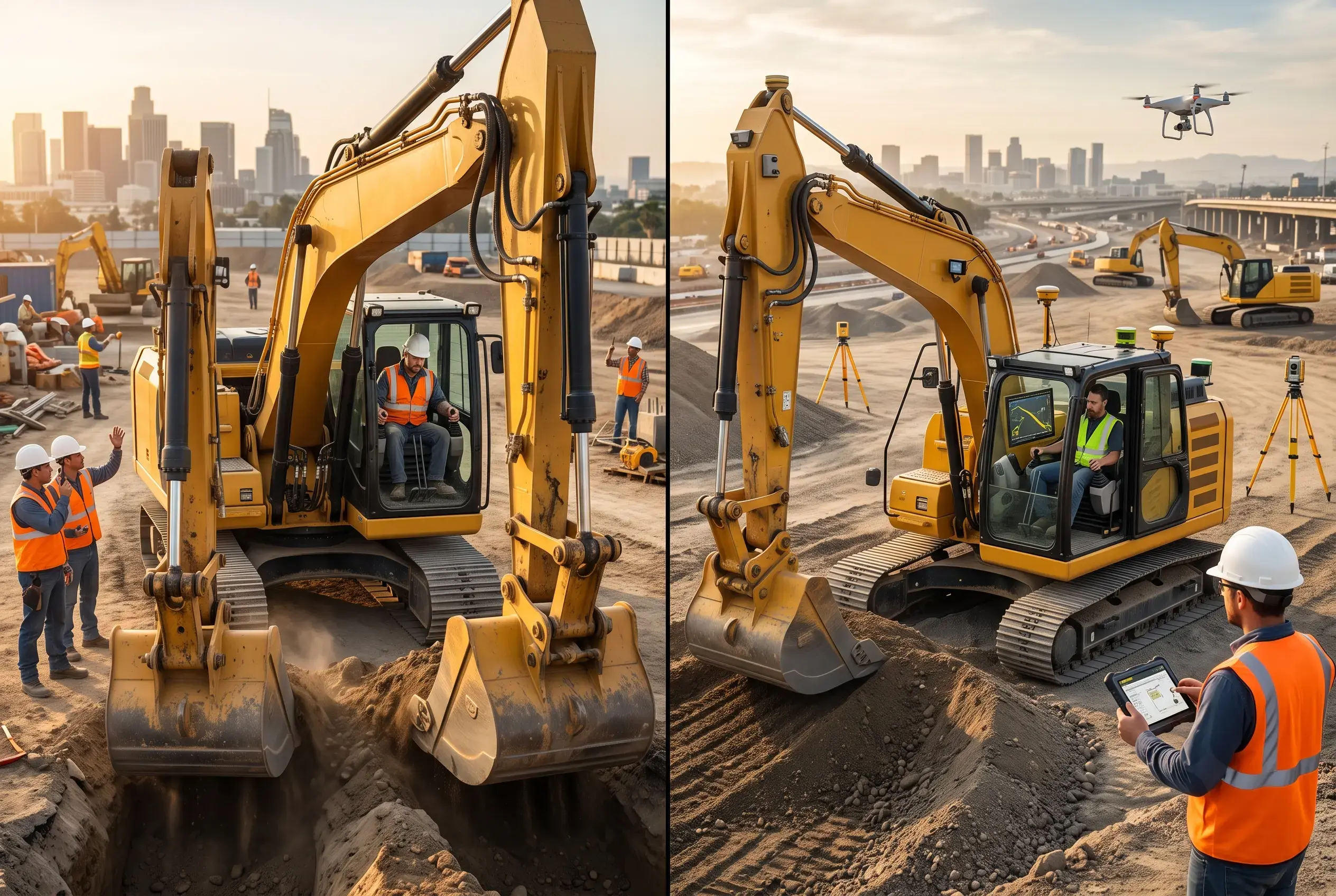
Compare the semi-autonomous and manual systems of modern heavy equipment. Find out which technology will provide the most efficiency, precision and return on investment at your active site.
Compare the semi-autonomous and manual systems of modern heavy equipment. Find out which technology will provide the most efficiency, precision and return on investment at your active site.
Modern construction is undergoing a technological revolution, which leaves fleet owners with an important operational decision. The modern construction landscape is undergoing a massive technological evolution, leaving fleet owners with a critical operational choice.
The ability to control manual machinery relies on the experience, sharp vision, and physical reflexes that the operator behind the joysticks has. This is especially true in highly unpredictable environments such as demolition zones or mountainous terrains. A skilled operator can "feel" the sudden change in soil density using hydraulics. They can also spot hidden utility cables buried in muddy ditches and adjust their digging path in real-time. Manual machines are more reliable than computers because they do not rely on digital sensors.
Read Volvo Construction Equipment: 4 Facts Every Buyer Should Know
Combining human oversight and advanced software guidance can create an operating environment that is incredibly precise. The choice between semi-autonomous and manual systems on modern heavy equipment will determine how closely your civil projects adhere to design tolerances. These features, such as automated grade control, 3-D mapping and bucket-leveling, continuously guide the hydraulics of the machine, ensuring an operator can cut perfectly within millimeters on the first pass.
Your daily fuel and production reports will show you the immediate benefits of assisted machine control. Semi-autonomous configurations reduce the amount of over-excavation and the need to continually backtrack for slopes and sub-grades. The optimized workflow will ensure that your heavy equipment uses less fuel per ton of material moved, resulting in fewer engine hours and reduced structural wear.
Upgrade your fleet to high-tech automated machines by carefully considering your capital allocation strategy. heavymachinery Heavy machinery that has 3D guidance integrated in the factory commands a significant financial premium compared to fully manual counterparts. Contractors can recover the upfront capital in a few months by eliminating manual staking and reducing raw material waste. Many modern manual machines can be upgraded, which allows fleet managers to gradually install retrofit autonomy packages as project budgets increase, preventing immediate financial strain.
Digital assistance helps newer drivers to perform at the same level as veteran drivers from day one. The most profitable jobs of tomorrow will be based on a mixed fleet strategy that uses simple manual trucks to perform basic, short-term haulage, and semi-autonomous dozers and excavators for precision civil work.
It is not about picking a winner but about choosing the best technology for your project. Although raw manual operation is still the best option for localized, highly unpredictable tasks, a strategy based on manual operations or a semi-autonomous system in modern heavy equipment will allow you to scale your commercial operations. These hybrid systems protect your workers by enforcing digital boundaries while unlocking perfect grading accuracy. They also help fleet owners to secure more contracts, increase profit margins and build infrastructure efficiently.
These systems are not designed to replace the driver. They're meant to help them.
Yes.
The machine uses automated depth limits and precision GPS to prevent over-digging. It also reduces fuel consumption per project.
The traditional manual operation can be more reliable than digital sensors in turbulent weather, as it relies on the human eye and mechanical controls.
This technology reduces the learning curve of less experienced operators. Automating the repetitive and precise aspects of the job (like keeping the blade level) allows for newer drivers to deliver better results faster.


Leave a comment
Your email address will not be published. Required fields are marked *