




Have you ever thought about why so many soldiers and construction workers call a modern hydraulic crawler excavator a "Poclain"? Learn about the long and interesting history of Georges Bataille's innovative French company that changed the earthmoving business.
Walk onto any major infrastructure project, quarry, or deep foundation site across the Middle East, South Asia, or Europe, and you will quickly notice a unique linguistic habit among the crew. Instead of asking for a tracked hydraulic excavator, supervisors, operators, and mechanics will tell you to bring over the "Poclain."
No matter if the machine in question is a brand-new model from Volvo, Komatsu, CAT, or Hyundai, the nickname stays the same. This common phrase is a great example of proprietary eponymy, which is when a single innovative brand changes the language used in an industry for good. Read Rain-Ready: Is Your Fleet Prepared for the Next Storm?
The phenomenon of calling an entire class of heavymachinery by a specific brand name happens when a company introduces a revolutionary technology before anyone else. Just as people use the word "Kleenex" for tissues or "Xerox" for photocopies, the global construction industry adopted Poclain because it was the first brand to commercialize high-pressure hydraulic digging systems.
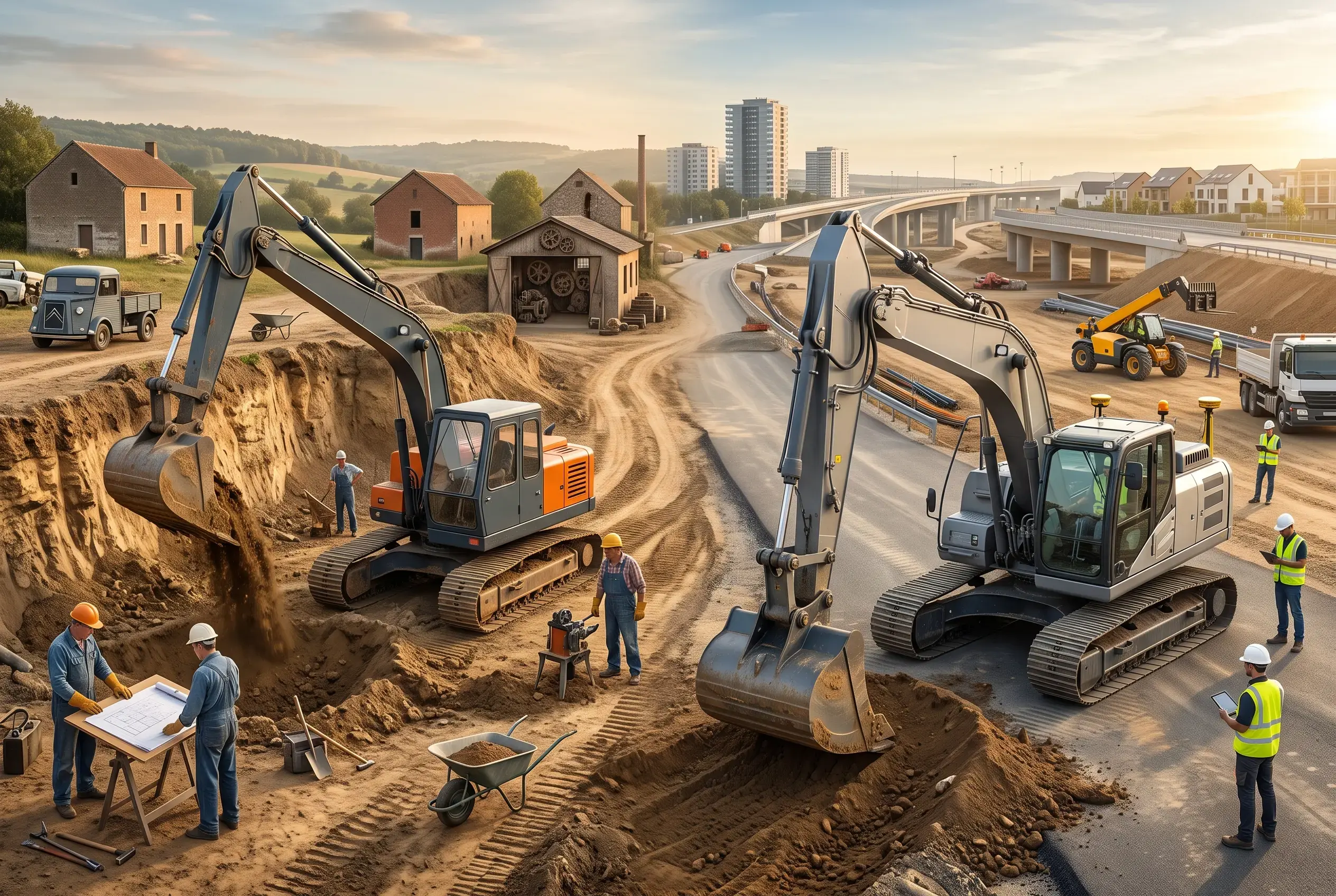
Before this industrial breakthrough, earthmoving machines relied on cumbersome, slow, and massive systems of mechanical steel cables, clutches, and winches.
When these new high-pressure hydraulic machines hit the job sites around the world during the huge construction and early infrastructure booms after World War II, they totally changed how precise and powerful machines could be. For an entire generation of operators, engineers, and contractors, this French gear was their absolute first introduction to modern hydraulic fluid power. Because there was no similar equipment available at the time, the name printed on the side of the red machine became permanently embedded in the minds of the workforce as the universal word for the tool itself.
Despite the industrial and mechanical weight the word carries today, the origin of the name has nothing to do with iron, steel, or hydraulics.
The story began back in 1927 in Le Plessis-Belleville, France, when an ambitious, mechanically-minded farmer named Georges Bataille started a small repair workshop for agricultural machinery. The workshop was built next to a nearby field with a special pond that was once used by the local textile industry to soak or "macerate" flax fibres.
In the local Picard dialect spoken in that part of France, a flax-macerating pond was traditionally referred to as a "Poclain." Over decades of local usage, this rural geographic phrase naturally contracted into the single word "Poclain." When Bataille needed a name for his growing company, he adopted the title of the land, completely unaware that his localized farming workshop would eventually evolve into a multi-national heavymachinery empire.
The true turning point for the company occurred in 1951 when they moved away from standard farming trailers to build the legendary TU model. This machine is widely recognized by historians as the world's very first fully hydraulic excavator, utilizing a pressurized pump system to move the boom and bucket instead of wire ropes.
A few years later, the brand perfected the continuous 360-degree rotation of the upper structure turret, establishing the exact design blueprint that every single modern excavator uses to this day.
What truly set these machines apart from early competitors was the development of specialized high-pressure hydraulic motors and variable displacement systems. This allowed the relatively compact machines to exert massive breakout forces at the bucket teeth, making them indispensable for tough quarry work, mining operations, and deep trenching. The distinctive ruby-red units quickly became symbols of engineering excellence, manufactured under international licensing agreements across multiple continents.
While the iconic red excavators are no longer rolling off assembly lines, the structural impact of the brand remains completely alive on modern job sites. In the late 1970s and 1980s, the excavator manufacturing division was steadily absorbed by the American industrial giant CASE, with the machines eventually transitioning from their classic red paint to standard construction yellow.
However, the original hydraulic component division split off to become an independent entity, remaining a powerhouse in modern component manufacturing.
The fact that a supervisor will still look at a 20-ton modern crawler digger and call it a Poclain is a testament to the power of market-defining innovation. Older generations of heavy machine operators taught younger apprentices using that exact vocabulary, passing down an informal piece of industrial heritage.
It serves as a reminder that the companies that take the initial, massive risks to pioneer a brand-new mechanical technology can successfully claim a permanent spot in our everyday language.
The reason we call hydraulic excavators a Poclain is a story of market dominance, breakthrough engineering, and a linguistic habit that outlived the original machine line. Georges Bataille's transition from a rural French flax-pond workshop to pioneering high-pressure fluid power fundamentally shaped the modern construction landscape. Understanding this history gives us a deeper appreciation for the rugged, precise earthmovers that continue to build our world today.
Is Poclain still manufacturing hydraulic excavators today?
No, the excavator manufacturing division was sold to CASE in the late 20th century, and production under the original brand name stopped. However, the company still exists independently as a global leader in high-performance hydraulic components and motors.
What did Poclain come up with that made excavators famous all over the world?
They pioneered the commercial use of high-pressure hydraulic systems and 360-degree continuous turret rotation, replacing the slow, dangerous cable-and-winch systems used by older earthmovers.
In which regions of the world is the term Poclain most commonly used for excavators?
The term remains highly popular among contractors and site laborers throughout the Middle East, parts of South Asia (especially Southern and Eastern India), France, and several European regions.
What did the original word Poclain mean before it became a machinery brand?
The name comes from a local French Picard dialect phrase "poque à lin," which translates to a "flax pond," referring to the specific geographic site where the original agricultural workshop was built.
What was the largest machine ever built by the original French company?
The largest model was the massive Poclain 1000, which was once the biggest production hydraulic excavator in the world, weighing up to 190 tons and handling massive buckets for heavy mining operations.


Leave a comment
Your email address will not be published. Required fields are marked *