




Learn how Sharjah’s Middle Line drainage project (worth Dh500m) is being driven by a fleet of heavy equipment, using advanced trenchless technology and excavation techniques to protect the city from urban flooding.
In Sharjah, the unpredictable coastal weather patterns and expanding city limits have made long-term climate resilience an absolute priority for municipal planners. Even the most modern urban economies can be brought to a grinding halt by flash floods and sudden rainstorms.
The Strategic Stormwater and Groundwater Main Line Project, managed by Sharjah Municipality, is one of the largest underground drainage projects in the region. The first phase of the multi-million dirham project is managed by Sharjah Municipality and creates an effective drainage system across a large area. The main line is a 3-meter-wide concrete pipe that will channel water directly into the sea.
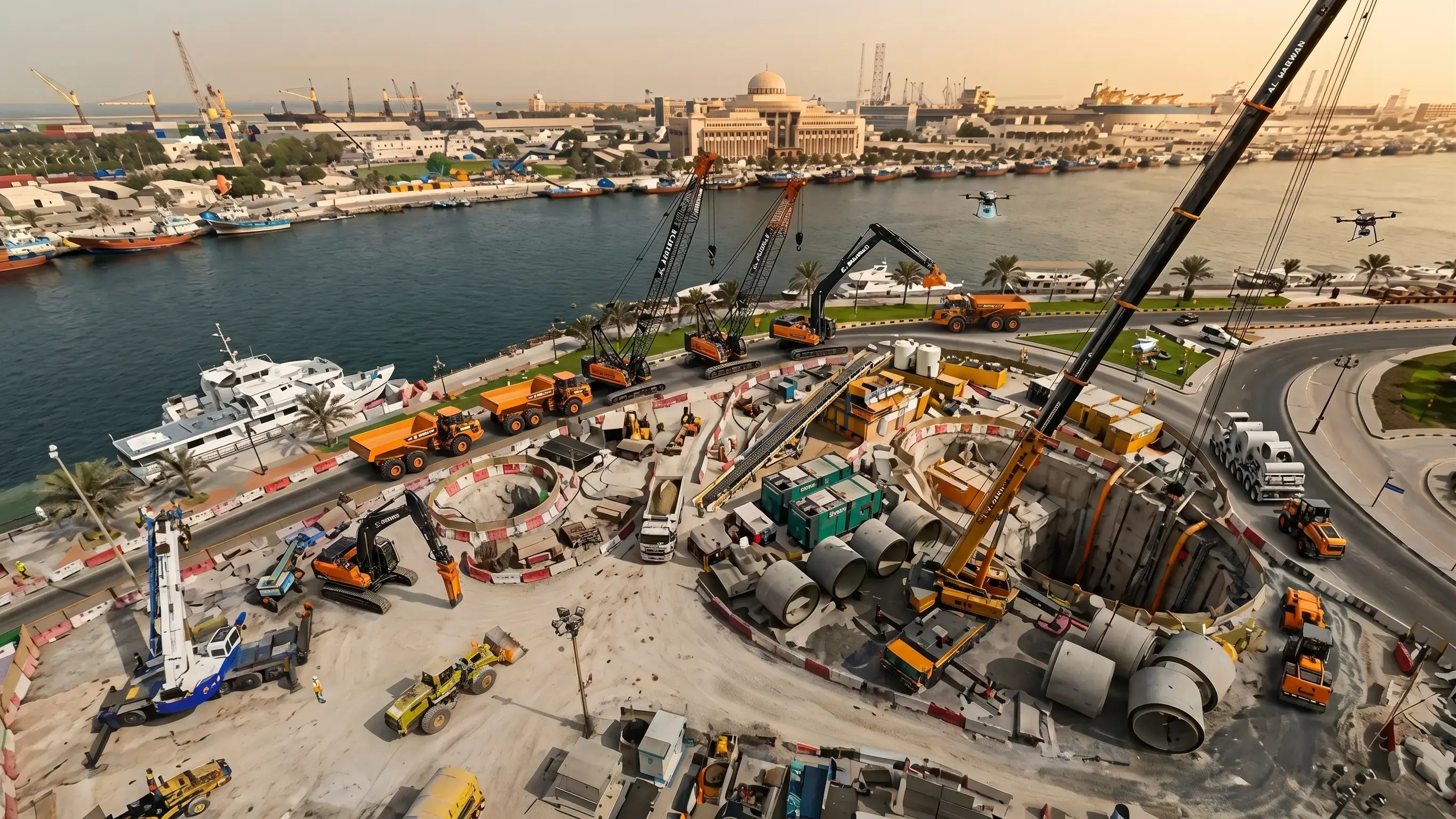
The excavation of massive receiving shafts and launching pits from the surface is done by heavy-duty crawler excavators with long reach and reinforced rock buckets.
They work in tandem with wheel loaders and heavy dump trucks to move thousands of tons of earth quickly, keeping surface traffic moving smoothly. These machines work with wheel loaders of high capacity and heavy dump trucks in order to move thousands of tons of earth quickly.
Contractors are using microtunneling trenchless instead of open cuts to maintain Sharjah's vital road network.
The method uses hydraulic jacking machines of high tonnage, which are positioned at the bottom of deep launch shafts. The massive hydraulic cylinders are used to push concrete pipe sections of 3,000 mm forward, section by section. The microtunneling machine (MTBM), which has a rotating cutterhead, leads the underground path. Operators guide its trajectory with laser-guided systems.
The lifting capacity of crawler cranes is critical to the success of all active projects.
The large cranes are capable of performing continuous lifts with high precision and lowering heavy pipe segments up to 3 meters wide into position. Telescopic handlers work quickly alongside these large cranes to supply the shaft edges with structural components, pipe joints and heavy seals.
Contractors must deploy large-capacity pile rigs to prevent soil shifting and water flooding before they begin digging.
The heavy rigs are used to drive interlocking concrete secant walls and steel sheet piles deep into the earth. This creates an impermeable, watertight perimeter that can withstand immense lateral pressure. These heavy rigs are accompanied by high-pressure grouting pump systems and a continuous dewatering system to ensure that the underground construction zone is dry and safe for workers.
This project demonstrates what can be done when modern engineering is combined with powerful heavy machinery. The emirate builds vital infrastructure while causing minimal disruptions to the daily life of its citizens. This hidden network of massive lines is shielding the community as teams work towards the completion date in 2027. Heavy machinery is working below the surface to ensure a safe, dry and flood-resistant Sharjah in decades to come.
The project is an underground infrastructure of Dh500m designed to collect rainwater, groundwater, and drainage across 22 districts in Sharjah and direct it safely into the sea.
The main pipeline has a huge internal diameter of 3 meters and is installed between 13 meters and more than 20 metres underground.
Pipe jacking is a method of installing large underground pipelines without removing the top layer. This allows major city roads such as Al Wahda Road to remain fully operational.
The project is based on crawler excavators with long reach for shaft excavation, heavy-duty pile rigs to support the soil, high-tonnage gantries for lifting pipes, and hydraulic jacking machines for microtunneling.
This major infrastructure project to protect against flooding is expected to be completed by February 2027.


Leave a comment
Your email address will not be published. Required fields are marked *