






160-Ton Super Massive Excavators: The Ultimate Mining & Marine Guide
High-bench aggregate extraction, deep-channel marine dredging, and coastal land reclamation across the United Arab Emirates require heavy-duty machinery. Standard excavators lack the hydraulic power and structural reach needed to process millions of tons of hard rock or safely clear deep harbor beds.
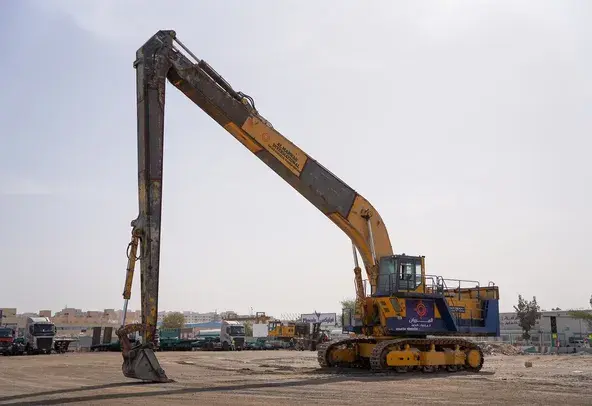
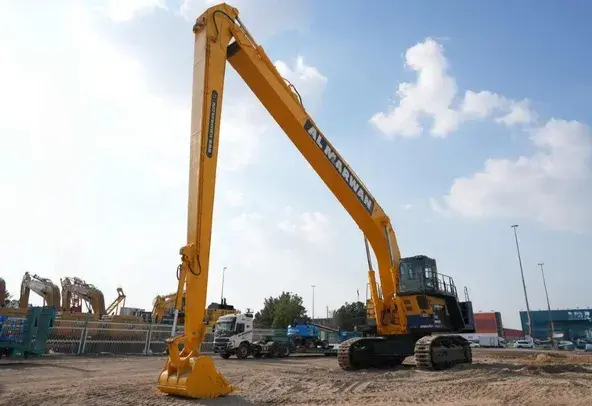
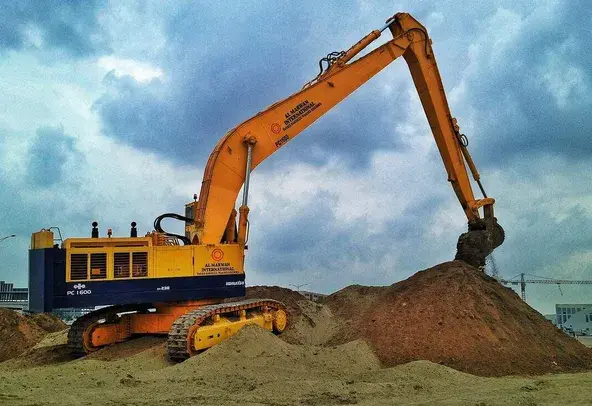
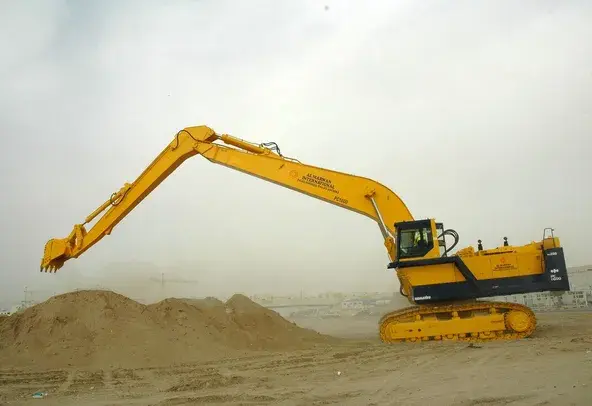
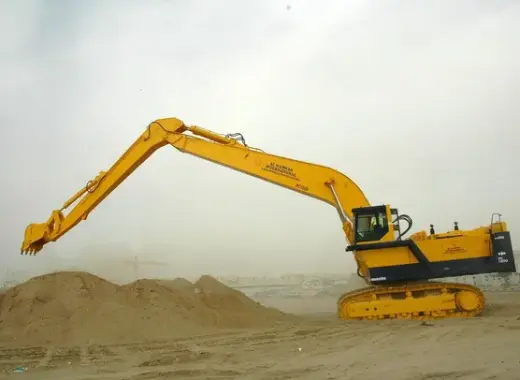
To overcome these physical limits, tier-one contractors and marine engineering firms rely on 160-ton super massive excavators equipped with 28- to 32-meter long-reach booms. These industrial giants provide an expansive operating radius without the constraints of fixed cable shovels. Consequently, they bring true mining-scale performance to major infrastructure projects in Dubai, Abu Dhabi, and the Northern Emirates.
Technical Performance Profile of the 160-Ton Excavator
Operating an excavator with a 32-meter front-end assembly creates extreme mechanical stress on pins, welds, and hydraulics. Moreover, intense heat waves, fine silica sand, and corrosive saltwater in the Gulf region cause standard machinery to wear out quickly.
To withstand these harsh operating conditions, specialized long-reach fleets feature reinforced components designed for high-pressure work:
- Smart Power Density in High-Displacement Powertrains: A high-displacement industrial diesel engine powers this 160-ton machine. Engineers tuned the engine to produce massive torque at low speeds. As a result, the excavator drives its hydraulic pumps through dense rock without stalling. Electronic management systems monitor engine loads in real time to optimize fuel injection curves, keeping running costs low.
- Independent Flow Control and High-Pressure Hydraulics: Dual-displacement axial piston hydraulic pumps convert raw engine output into physical force across a 32-meter reach. Advanced flow-regeneration valves maintain maximum fluid pressure down the long boom. Thus, the system delivers strong digging forces alongside smooth multi-function control.
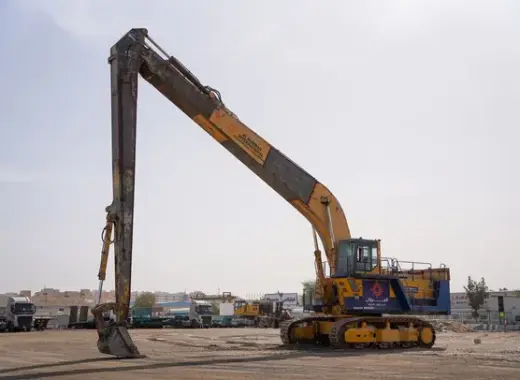
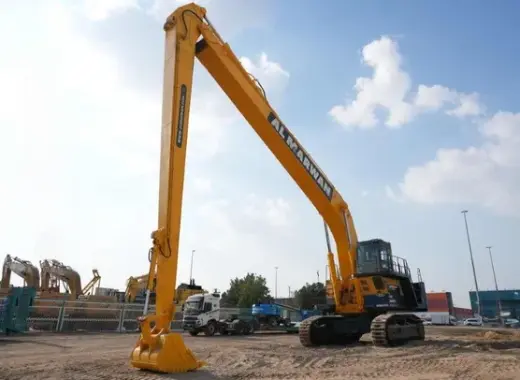
- Advanced Boom Geometry (28–32 Meters): Fabricating a 32-meter boom requires advanced structural design. Built with thick steel castings, internal cross-baffles, and oversized pivot pins, these extended booms resist severe twisting forces without flexing or cracking. Furthermore, the wide operating radius allows operators to reach high vertical walls or dig deep underwater channels accurately.
- Sealed Track Links and Heavy-Duty Mining Chassis: Extending a heavy boom creates significant leverage on the base frame. To maintain stability, the 160-ton base uses heavy counterweights and an extra-wide undercarriage. Additionally, sealed and lubricated track links (SALT design) block out sand, saltwater, and quarry dust to prevent premature component wear.
Key Operational Advantages
Configuring a 160-ton super massive excavator with an extended 28- to 32-meter long-reach boom offers distinct advantages over standard mass-excavation models:
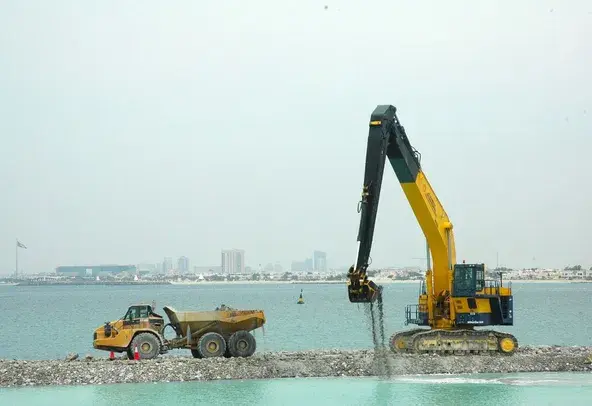
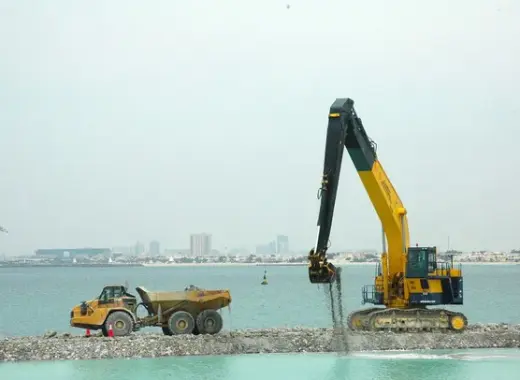
- Elimination of Mobile Dredging Barges: Shallow-water excavation usually requires flat-top barges, tugboats, and complex mooring anchors. However, a 160-ton long-reach machine can travel directly along jetties or breakwaters to perform deep underwater dredging at a fraction of the cost.
- Extended Excavation Safety Radius: Working near unstable edges presents serious safety risks during deep trenching or quarrying. Thanks to the 32-meter reach, the heavy machine remains safely parked on solid ground while the bucket digs deep within the excavation zone.
- Reduced Fleet Relocation Cycles: The extended horizontal and vertical reach lets operators clean, grade, or extract larger surface areas from a single position. Fewer repositioning moves lead to faster truck loading times and higher overall daily output.
- Optimized Multi-Function Balancing: Heavy counterweights and wide crawler tracks maintain smooth control at full extension. This balance prevents chassis swaying during high-speed swings, protecting internal components from sudden shock loads.
Primary Uses and Job Site Applications
In the Gulf region, contractors rely on 160-ton long-reach excavators across several high-value sectors:
- Deep Port Development & Marine Reclamation: As the UAE expands its coastal terminals and maritime basins, these machines grade underwater slopes, clear marine clay, and place heavy rock armor along breakwaters.
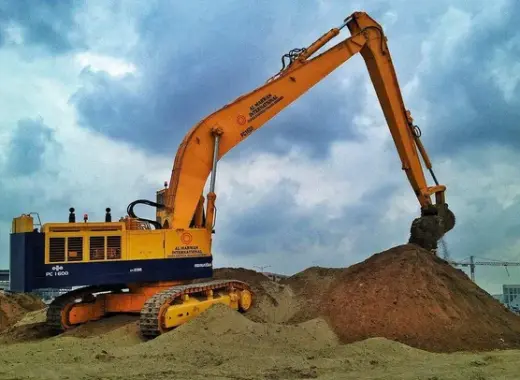
- High-Bench Quarry Extraction: In the mountainous aggregate fields of Fujairah and Ras Al Khaimah, these 160-ton units sit on high quarry benches to load blasted rock directly into mobile crushers.
- Mega-Substructure Foundations: Heavy energy infrastructure, industrial plants, and water treatment facilities require deep foundation clearing. Long-reach excavators quickly move large volumes of material while cleanly shaping deep foundation footprints.
Overview
A 160-ton super massive excavator equipped with a 28- to 32-meter long-reach boom is a specialized tool that turns complex deep-earth and marine projects into profitable operations. Investing in a platform built for extreme desert heat and saltwater environments gives your team the power to execute ambitious coastal and infrastructure builds with complete confidence.
Ultimately, high-capacity machinery requires a dedicated regional support network. At our heavy equipment facility in Dubai, United Arab Emirates, we support your assets throughout their operational lifecycle with comprehensive technical service, preventative maintenance, and genuine replacement parts.
Frequently Asked Questions
1. What popular excavator models belong to the 150- to 200-ton super-massive class?
Key models in this weight class include the Caterpillar 6015 / 6020B, Komatsu PC1250 / PC2000, Hitachi EX1200 / EX1900, and Liebherr R 9150 / R 9200. These production machines generally produce between 800 and 1,100 net horsepower.
2. How does an extended 32-meter boom affect bucket capacity on a 160-ton excavator?
Because a 32-meter boom creates strong leverage on the machine, bucket sizes are downsized to preserve stability. While standard booms carry 7.0 to 12.0 cubic meter buckets, long-reach configurations typically use specialized 3.0 to 5.0 cubic meter heavy-duty rock or dredging buckets.
3. Why are long-reach 160-ton excavators preferred over dredging barges for shoreline work?
Operating on land eliminates expensive barge rentals, tugboat operations, marine crew costs, and weather-related maritime delays. A shoreline-based long-reach excavator sets up quickly, moves under its own power, and loads dump trucks directly from the breakwater.
4. How do cooling systems protect 160-ton excavators operating in Gulf desert heat?
Working in temperatures over 50°C puts extreme thermal stress on large hydraulic systems. Super-massive excavators use oversized radiators, independent oil coolers, and variable-speed reversing fans to keep fluid temperatures within safe operating limits during 24/7 cycles.
5. How is a 160-ton long-reach excavator transported to a job site in the UAE?
Due to highway weight and size limits, a 160-ton excavator is disassembled for transport. The counterweights, tracks, boom sections, and stick are hauled separately on specialized lowboy trailers, then reassembled on site using mobile cranes.